 Електронні компоненти і системи


Starting with the fifth-generation single-board computers Raspberry Pi 5, the Raspberry Pi team introduced a new manufacturing process that changed the approach to connector assembly on PCBs – intrusive reflow soldering. Thanks to this change, the production of Raspberry Pi 5 became 15% faster, the number of returned devices was halved, and the assembly process became significantly simpler and more efficient. The annual reduction of CO₂ emissions as a result of implementing the intrusive soldering technology is estimated by the company at 43 tonnes.
How are electronic modules manufactured on a modern production line?
Modern electronics manufacturing is dominated by Surface Mount Technology (SMD) — components are mounted by automated pick-and-place machines onto the surface of a PCB with solder paste already applied. Then, the whole board passes through a reflow oven, where the paste melts and the components are securely fixed. This process is fast, precise, and scalable.
What are through-hole components?
However, DIP components (also called through-hole, PTH, or pin components), such as USB ports, GPIO headers, and power connectors, have leads that go through the board. To ensure reliable mounting, these leads need to be soldered from the opposite side of the board — that is, they require soldering into plated through holes (PTH). And this is where the difficulties begin.
Why does the need to mount through-hole components complicate the typical manufacturing process?
The typical through-hole component assembly process looks like this:
SMD components are placed and soldered in the standard way. Then through-hole components are installed separately — previously manually (an operator inserted connectors by hand), later — using special-purpose robots. The board goes for wave soldering: its underside passes through a bath of molten solder, which “fills” the holes with the leads.
This traditional approach to through-hole component mounting has several disadvantages:
-
Slow: it’s an extra stage that breaks the main production flow.
-
Additional equipment: the wave soldering machine is a separate unit that requires maintenance, setup, and space on the line.
-
WIP (Work in Process): since wave soldering is not integrated into the main line, unfinished products accumulate at this stage, requiring storage, transportation, and synchronization.
-
Less precision: high-density components or those placed near plastic may be damaged by the temperature of the wave.
-
Design process is more complicated: clearances, solder masks, no-flux zones, and so on must be considered.
And most importantly — all of this makes a fully continuous “conveyor” flow impossible. In real production, this means delays, additional costs, and increased demands on process management.
How does intrusive reflow soldering solve this problem?
The intrusive reflow soldering technology combines the best of both worlds: allowing the strength and reliability of through-hole mounting, but without breaking the unified automated flow. This is a huge step forward for the production of compact and reliable devices — like the Raspberry Pi.
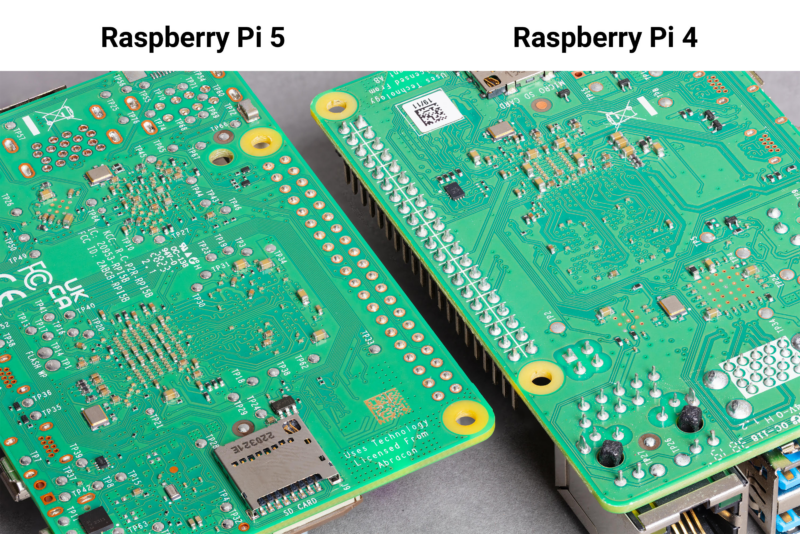
Raspberry Pi 5 і Raspberry Pi 4 with through-hole components installed in different ways. Photo from https://www.raspberrypi.com/
Advantages of the intrusive reflow soldering method in production
-
One line — no breaks. There is no longer a need for additional equipment to solder connectors.
-
Simpler planning and less WIP. All components are installed in a single process. Intermediate storage of unfinished products (Work In Process) disappears.
-
Fewer design complications. During implementation, the company refined connector designs, adapted the solder paste stencil pattern, modified mounting holes, and set up quality control. All this is now available to manufacturers who use Raspberry Pi in their own devices.
What are the benefits of introducing intrusive reflow soldering for Raspberry Pi customers in Ukraine?
Halving the return rate indicates stable quality. Fewer assembly defects mean less servicing, rework, and unpredictable delays. Raspberry Pi 5 has become an even more reliable tool for commercial projects, automation, education systems, and embedded solutions.
And what about the compatibility of Raspberry Pi 5, where components are installed using the new method, with other Raspberry Pi modules?
Externally, the changes are barely noticeable: some connectors have shorter pins, since they are no longer intended for wave soldering. However, all components remain electrically and mechanically compatible with previous versions. Moreover, the new technology allowed for increased assembly density without sacrificing reliability.
The technology is not new — but now it’s the standard.
The pin-in-paste method has been known in the industry for over a decade, but it required close coordination between the engineer and the manufacturer — a precise selection of pin length, hole diameter, and amount of paste. Now Raspberry Pi has implemented it at the mass production level — reliably, stably, without compromises.
This is not just a process change — it’s a new manufacturing standard for the entire Raspberry Pi lineup.
How through-hole DIP components are mounted using the intrusive reflow soldering (Pin-in-paste) method
VD MAIS is the official distributor of Raspberry Pi in Ukraine.
We supply only genuine devices with the new manufacturing standard, complete with full technical support and warranty. You can purchase Raspberry Pi single-board computers in Ukraine from the official VD MAIS online store.
To learn more about priority supply for large projects, email: raspberrypi@vdmais.ua.

